

Altitude Sickness in Adi Kailash : Symptoms & Prevention Guide
I have led multiple expeditions into the Vyas Valley and at high altitudes, and if there is one thing I’ve learned, it’s that the mountain doesn’t care about your gym records. I’ve seen marathon runners struggle while 70-year-olds climb with ease. Altitude sickness isn’t a sign of weakness—it’s a biological process of adaptation. At ThrillVana, we don’t just ‘guide’ you; we monitor your acclimatization every hour. Here is the unvarnished truth about staying safe at 15,000+ feet.
Kapalabhati or Anulom Vilom that you recommend your yatris practice 30 days before the trip. This connects your spiritual brand identity with physical safety.” — Founder of Thrillvana
Altitude sickness is the most misunderstood risk of Himalayan travel. While it sounds intimidating, the reality is that altitude sickness in Adi Kailash is manageable, predictable, and—with the right pace—completely preventable.
What is Altitude Sickness in Adi Kailash?
Technically known as Acute Mountain Sickness (AMS), it occurs when your body cannot adapt quickly enough to the lower oxygen levels at higher elevations. In the Adi Kailash circuit, you will be spending significant time above 3,500 meters (11,500 ft), where the air is significantly thinner.
The “Golden Rule” of the Vyas Valley
If you feel unwell at high altitude, it is altitude sickness until proven otherwise. Never dismiss a headache as “just exhaustion” or “lack of sleep.”
Recognizing Symptoms of Altitude Sickness in Adi Kailash

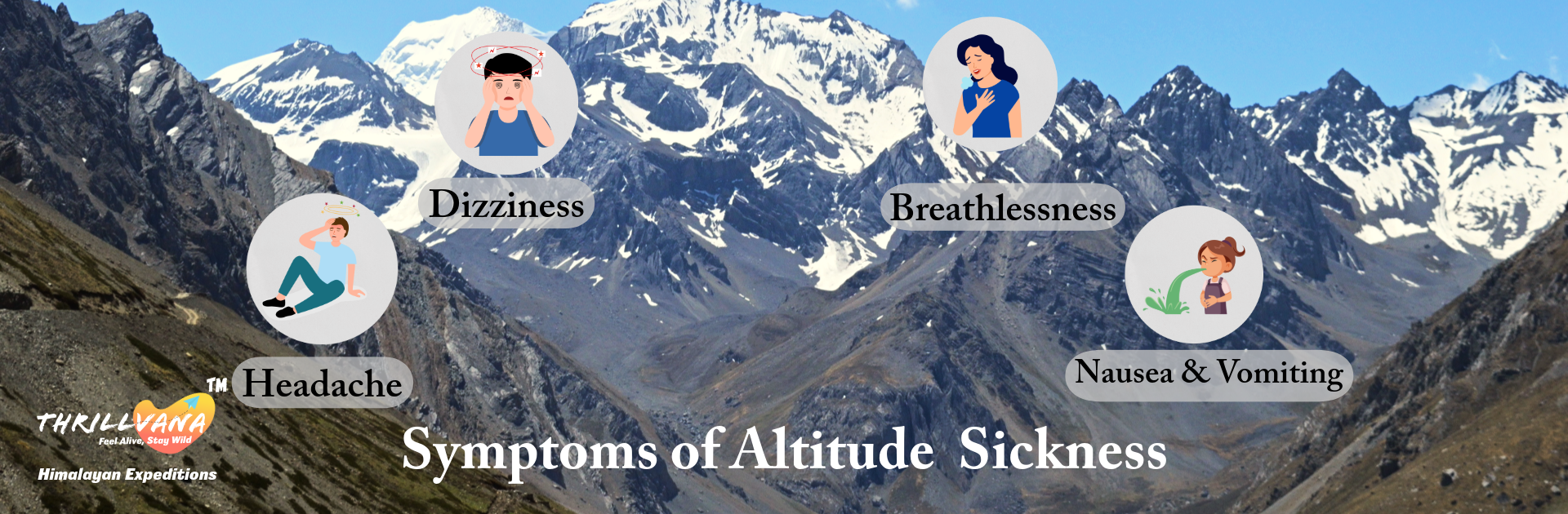
This visual clearly represents how altitude sickness can feel during the journey.
Key Symptoms to Watch:
- Headache | Nausea or vomiting | Shortness of breath | Dizziness | Fatigue
These are early signs — don’t ignore them.
Why It Happens in Adi Kailash
- Rapid altitude gain
- Reduced oxygen levels
- Dehydration
- Overexertion
Most issues happen due to lack of awareness, not danger.
Recognizing Severe Altitude Sickness: HAPE and HACE
While most travelers only experience mild AMS, it is vital to distinguish between the two severe forms of altitude sickness in Adi Kailash & in the Himalayas:
HAPE (High Altitude Pulmonary Edema): Fluid buildup in the lungs. Watch for a persistent dry cough, chest tightness, and a “gurgling” sound while breathing.
HACE (High Altitude Cerebral Edema): Swelling of the brain. This is a medical emergency. The clearest sign is Ataxia—if a person cannot walk in a straight line or appears “drunk” and confused, they must descend immediately.
The Medical Standard: Lake Louise Scoring System
At ThrillVana, we don’t guess; we measure. We use the Lake Louise Scoring System, the global medical standard for diagnosing AMS. We evaluate:
Headache: (0-3 points)
Gastrointestinal symptoms: (0-3 points)
Fatigue/Weakness: (0-3 points)
Dizziness/Lightheadedness: (0-3 points)
A total score of 3 to 5 indicates mild AMS. A score above 6 means the traveler must stop ascending and potentially descend.
Monitoring SpO2 Levels at High Altitude
A Pulse Oximeter for trekking is the most important tool in your kit. It measures your peripheral oxygen saturation (SpO2).
Normal (90% – 95%): Good adaptation.
Caution (85% – 89%): Your body is working hard. Increase hydration and rest.
Warning (Below 85%): This is a red flag. At this level, we administer supplemental oxygen and monitor for descent.
Why the Gunji Rest Day is Non-Negotiable
In the Adi Kailash circuit, Gunji (3,500m) is the most critical point for your body. It is the “Acclimatization Hub.” We intentionally schedule a Gunji rest day to allow your red blood cell count to increase before pushing toward the 14,000+ ft heights of Om Parvat and Jolingkong. Skipping this day significantly increases the risk of HAPE.
The Most Important Rule — Go Slow

The “Climb High, Sleep Low” Strategy
Your body acclimatizes best when you expose it to higher altitudes during the day but sleep at a lower elevation. This is why our itineraries include specific rest days in Gunji before pushing toward Jolingkong.
How to Prevent Altitude Sickness in Adi Kailash

Prevention is 90% of the battle. At ThrillVana, we follow a strict “Safety-First” protocol to ensure our travelers stay healthy.
Hydration: Your Biological Engine
To combat altitude sickness in Adi Kailash, you must drink 4–5 liters of water daily.
Pro-Tip: Add ORS or electrolytes. Water helps your blood carry oxygen more efficiently to your brain and muscles.
Dietary Discipline
Eat: High-carbohydrate, warm meals (Dal, Rice, Soups).
Avoid: Alcohol, smoking, and heavy sleeping pills. These suppress your breathing rate, making AMS much worse.
Altitude Sickness and Treatment
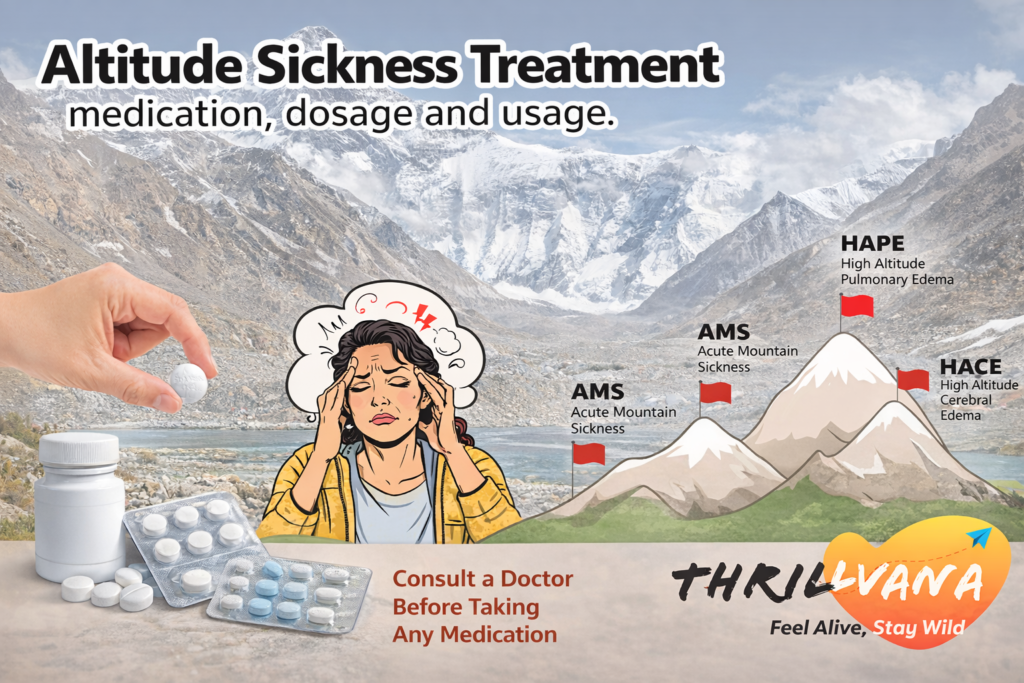
While many travelers consider Acetazolamide (Diamox) to help prevent altitude sickness in Adi Kailash, it is not a “magic pill.”
Consult a Doctor: Never self-medicate. Diamox is a sulfonamide (a sulfa drug); if you are allergic to sulfa, it can be dangerous.
Oxygen Support: All ThrillVana expeditions carry portable oxygen cylinders and pulse oximeters to monitor your SpO2 levels daily.
Emergency Evacuation & Medical Support
If altitude sickness in Adi Kailash symptoms become severe, we initiate our emergency evacuation from Dharchula protocol.
Dharchula MI Room: We maintain coordination with the Military Inspection (MI) Rooms and Army medical camps at Gunji and Nabhidang. These are the highest-quality medical facilities available in the border region.
Logistics: Descent is the only “cure” for severe AMS. Our team is trained to facilitate rapid transport back to lower altitudes where oxygen pressure is higher.
Myth:
Only unfit people get altitude sickness
Reality:
Anyone can be affected
Myth:
Medicines can fully prevent it
Reality:
Acclimatization is key
Myth:
Drinking more water alone is enough
Reality:
Hydration helps, but it’s not the only factor
Final Thought — Awareness is Safety
Altitude sickness is not something to fear.
It is something to understand.
With the right pace, hydration, and awareness — most travelers complete Adi Kailash comfortably.
Explore Adi Kailash with ThrillVana
At ThrillVana, safety is built into the journey.
From acclimatization planning to on-ground support, everything is designed for a smooth experience.
- Start with How to Prepare for Adi Kailash Yatra
- Plan your trip using Best Time to Visit Adi Kailash
Final Thought: Respect the Mountain
The Himalayas reward those who are patient. Don’t rush your steps. Listen to your body, stay hydrated, and follow your guide’s instructions.
Plan Your Safe Journey
First Time? Read our [Adi Kailash Travel Guide] for route details.
What to Pack? Check the [Complete Packing List for Adi Kailash].
Book Your Spot: Join a [Safety-First Expedition with ThrillVana].
Yes. Age and fitness levels do not prevent AMS. Proper acclimatization is the only way to ensure safety.
Diamox is commonly prescribed, but it must only be taken after consulting an MBBS doctor, especially if you have sulfa allergies.
Yes, all our high-altitude expeditions carry emergency oxygen and medical kits to manage early symptoms of altitude sickness in Adi Kailash.