


Complete Packing List Adi Kailash Yatra – What You Actually Need (No Overpacking)
“After multiple expeditions to the Vyas Valley, I’ve seen that the mountain doesn’t care about your brand of jacket—it cares about your layering system. In the shadow of Om Parvat, temperatures can drop from 20°C to -5°C in an hour. This complete packing list Adi Kailash Yatra is designed to keep you light, warm, and spiritually ready for the journey.” — Rishi Raman, Founder of Thrillvana
Pack Smart, Not Heavy
One of the most common mistakes travelers make for Adi Kailash is overpacking.
Either they carry too much… Or they carry the wrong things.
The truth is simple:
This is not a trekking expedition, It is a high-altitude journey with short walking stretches.
Which means your packing should be practical, light, and purposeful
If you’re still preparing for the journey overall, you may want to read How to Prepare for Adi Kailash Yatra first.
How to prepare your packing list for Adi Kailash?
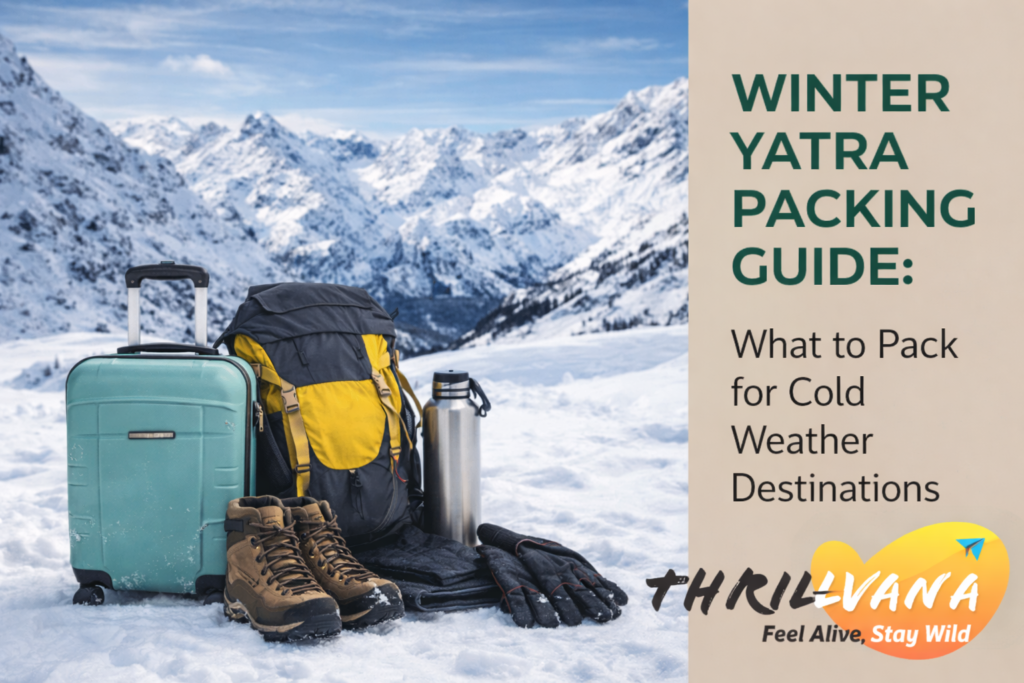
Before listing items for complete packing list Adi Kailash, it’s important to understand the approach:
- Weather changes quickly
- Temperatures drop significantly
- Comfort is basic
- Movement is limited
So the focus is: Layering + comfort + essentials
Clothing for 15,000ft: The Essential Layering System

Upper Body
- Thermal innerwear
- Full-sleeve t-shirts
- Fleece jacket
- Heavy outer jacket (windproof/water-resistant)
Lower Body
- Thermal bottoms
- Comfortable track pants
- Extra pair for backup
Accessories
- Woolen cap
- Gloves
- Warm socks (3–4 pairs)
Layering helps you adjust without discomfort
What are the best shoes for Adi Kailash Yatra?

Footwear — Keep It Comfortable (do not forget this in your complete packing list Adi Kailash Yatra)
You don’t need heavy trekking boots.
- Comfortable walking shoes
- Good grip
- Easy to wear/remove
You will walk short distances, not trek extensively
Must-have high altitude travel essentials
Keep this simple and focused:
- Personal medicines
- Sunscreen & sunglasses
- Lip balm & moisturizer
- Water bottle
- Power bank
Medical & Personal Care
- Basic medicines (as advised by your doctor)
- Personal prescriptions
- Small first-aid items
Avoid carrying unnecessary medication without guidance
Hydration — Don’t Ignore This
At high altitude, hydration matters more than you think.
- Drink water regularly
- Take small sips throughout the day
This helps your body adjust better
What You Should NOT Carry
This is just as important.
Avoid:
- Heavy trekking gear
- Too many clothes
- Fancy travel accessories
- Large suitcases
The lighter you travel, the easier your journey becomes
How to Pack Smart
- Use a medium-sized duffel/backpack
- Keep items organized in layers
- Carry only what you will actually use
Simplicity works best in the mountains
Packing Reflects Your Mindset
Packing is not just about items.
It reflects how you approach the journey.
If you pack with clarity and simplicity,
your experience becomes smoother and more enjoyable
The “Kapur” (Camphor) Trick:
“I always carry a small pouch of camphor. Sniffing it helps open up the lungs when the air gets thin near Jolingkong.” – Founder
The Sun Guard:
“The Himalayan sun at high altitudes is deceptive. I’ve seen bad sun-scalds even in cold weather—bring SPF 50 and UV-protected sunglasses.”
The “Dry Bag” Tip:
“The weather near Om Parvat can change in minutes. Keep your Aadhaar card and permits in a waterproof dry bag inside your backpack.”
While packing your physical gear, don’t forget to prepare mentally by reading about the [Ancient Legends of Adi Kailash]

Adi Kailash Packing FAQ: Expert Advice for a Smooth Journey
Not necessarily. Unlike high-intensity treks, this journey involves 4WD vehicle travel with only short walking stretches (3–4 km). A pair of high-quality, water-resistant walking shoes or hiking shoes with a solid rubber grip is sufficient. Ensure you "break them in" at least two weeks before the yatra to avoid blisters.
While most Himalayan expeditions require backpacks, you can carry a medium-sized suitcase for the Adi Kailash Yatra since your luggage is usually transported by vehicle to the guest houses. However, we strongly recommend a medium-sized duffel bag or a 40L backpack for better durability on mountain roads and ease of handling at high-altitude stays like Gunji.
Since you will cross multiple ITBP checkpoints near the Indo-Tibet border, you must carry:
Your original Aadhaar Card (mandatory).
The Inner Line Permit (ILP) issued at Dharchula.
A Physical Fitness Certificate signed by an MBBS doctor.
3–4 recent passport-size photographs.
Pro Tip: Keep these in a waterproof "Dry Bag" inside your daypack for quick access at checkpoints.
Generally, the yatra is open to those between 9 and 70 years of age. For senior citizens above 65, a stricter medical clearance is often required. Our itineraries are "slow-paced" to ensure older pilgrims have enough time for acclimatization at Gunji (10,500 ft) before proceeding to higher altitudes.
Hydration is your best friend. Drink 3–4 liters of water daily. Many of our travelers use the "Camphor (Kapur) Trick"—carrying a small pouch of camphor to sniff, which can help open the lungs. However, always consult your doctor about carrying Diamox as a preventive measure for Altitude Mountain Sickness (AMS).
Connectivity is extremely limited. BSNL works intermittently in some villages, but do not rely on it. Charging points are scarce in high-altitude homestays; we highly recommend packing a 20,000 mAh power bank to keep your phone and camera charged for those Om Parvat photos.